Healthcare Innovation in Spain: From Technological Development to Real-World Integration into the Healthcare System
by Persei vivarium, July 16, 2026
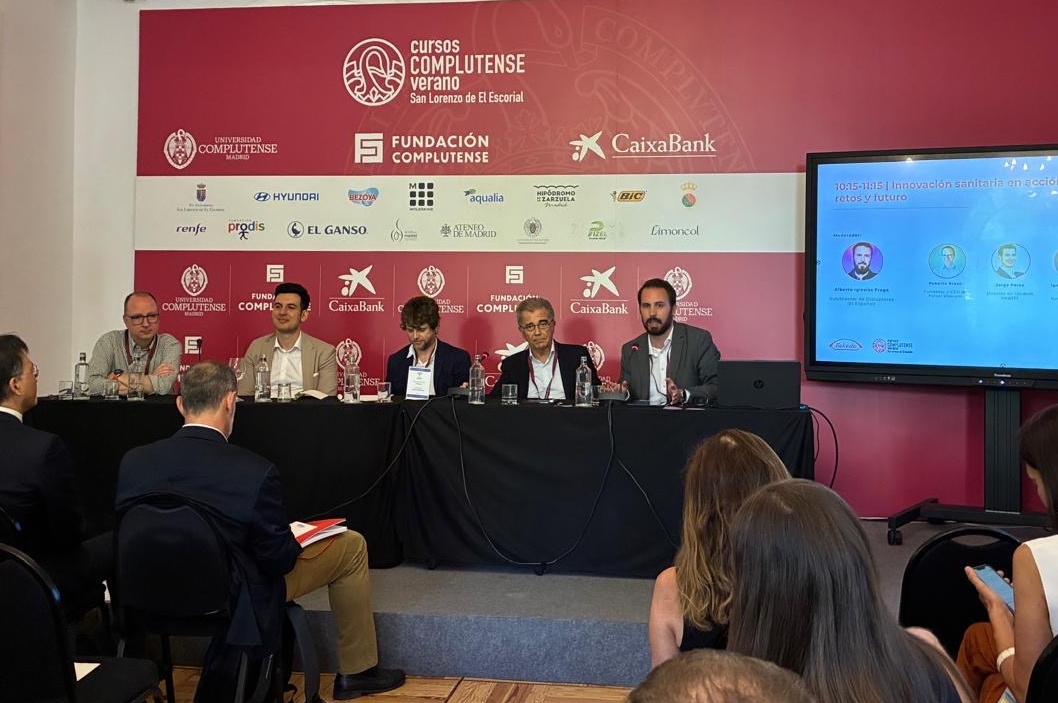
The Complutense University of Madrid Summer Course, “Biopharmaceutical Innovation in Spain: Competitiveness, Access and the Future of Healthcare,” organised in collaboration with Takeda, brought together representatives from public administrations, healthcare delivery, research, industry and patient associations to analyse the challenges that will shape the future of biopharmaceutical innovation in Spain.
Roberto Bravo, CEO and founder of Persei vivarium by Zelenza Group, took part in the roundtable discussion “Healthcare Innovation in Action: Success Stories, Challenges and the Future,” alongside Jorge Pérez, Director of Tandem Health; Ignacio H. Medrano, neurologist and founder of Savana and Mendelian; and Rafael Areses Gómez, Director of Emerging Technologies at Alebat. The session was moderated by Alberto Iglesias, Deputy Editor of Disruptores at El Español.
The roundtable highlighted that healthcare innovation is accelerating at an unprecedented pace, but it must not be limited to the development of new technologies. Its true value emerges when it is integrated into clinical practice and addresses the specific needs of patients and healthcare professionals, generating measurable clinical, operational and economic outcomes.
This was reflected in the different success stories presented during the event. The range of initiatives implemented shows that, although the transition from a pilot project to real-world deployment continues to pose challenges—such as system fragmentation, interoperability and data quality—these barriers can be overcome. Spain has a healthcare, research and business ecosystem capable of developing high-value projects.
Unsurprisingly, artificial intelligence and emerging technologies featured prominently in the discussion on the future of healthcare. These tools offer new opportunities to improve research, support decision-making, personalise care and develop more continuous and proactive healthcare models.
Another key message was the need to strengthen collaboration among public administrations, hospitals, universities, research centres and industry. Scaling innovation requires all these stakeholders to work together from the earliest stages, with shared objectives, clear evaluation models and a focus on implementation and sustainability.
In this context, the main challenge facing the Spanish ecosystem is not to generate more isolated projects, but to create the conditions needed for solutions that have already demonstrated their value to grow, become integrated and reach patients equitably.
The future of healthcare innovation will therefore depend not only on technological capabilities, but also on the ability to execute. Turning data, scientific knowledge and new digital tools into tangible improvements for the healthcare system requires collaboration, continuity, strategic vision and a firm commitment to measuring outcomes.
Share



Persei vivarium
by Zelenza Group